
Professional Erosion
Control and Pipe Supply
VISIT OUR NEW LOCATION IN SHERMAN
Control and Pipe Supply
VISIT OUR NEW LOCATION IN SHERMAN

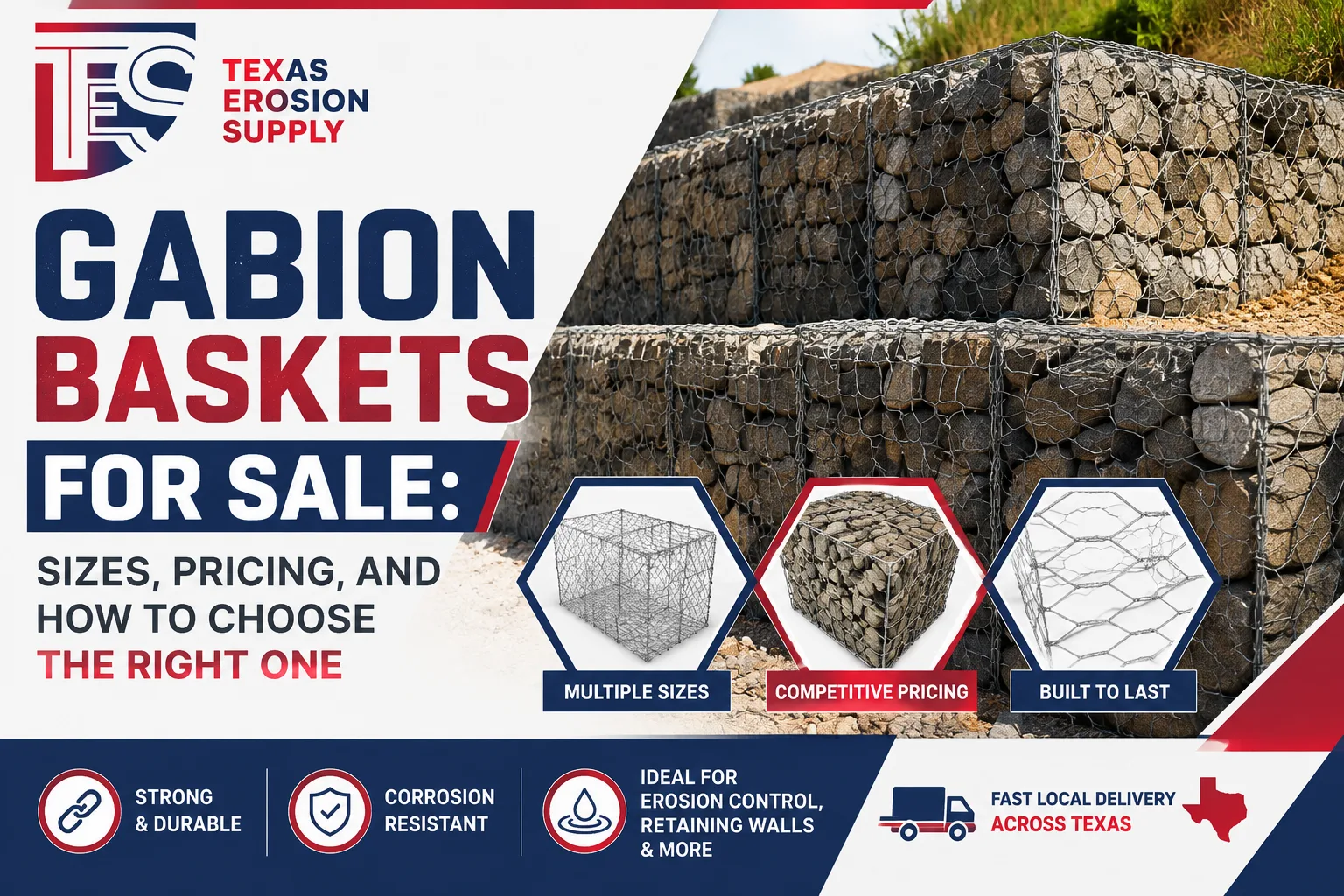
If you have priced out a gabion retaining wall, streambank stabilization project, or erosion barrier in Texas, you already know the first question is always the same: what size basket do I actually need, and what is this going to cost? Gabion baskets come in a wide range of sizes, wire types, and mesh openings, and picking the wrong combination can mean a wall that underperforms — or a budget that balloons for no reason. This guide breaks down basket sizing, what drives pricing, and how to choose the right gabion for your project.
A gabion basket is a welded or woven wire mesh container filled with rock, stone, or aggregate and used to build retaining walls, streambank armor, erosion barriers, and drainage structures. Once filled and stacked, gabion baskets create a flexible, permeable, gravity-fed structure that can settle slightly without cracking or failing — a major advantage over rigid concrete retaining walls on unstable or shifting Texas soils.
Gabion baskets are sized by length x width x height, and the right size depends on the wall height, available fill material, and how the structure will be assembled on site.
| Basket Size (L x W x H) | Typical Use | Notes |
|---|---|---|
| 3′ x 3′ x 1′ | Mattress/erosion armor | Low-profile, used flat for channel and streambank lining |
| 6′ x 3′ x 3′ | Standard retaining wall | Most common size for residential and light commercial walls |
| 9′ x 3′ x 3′ | Larger retaining wall runs | Fewer diaphragms per linear foot, faster to assemble on long runs |
| 6′ x 3′ x 1.5′ | Low walls, planters, edging | Common for decorative and landscape applications |
Custom sizes are also available for projects with specific engineering requirements — culvert protection, bridge abutments, and large-scale channel work often call for baskets sized to match a stamped design.
The two main construction types affect both price and performance:
Gabion basket cost is driven by four main factors:
Every project is different, but as a general planning range, gabion retaining walls in Texas typically run somewhere between $20 and $45 per square face-foot installed, depending on wall height, wire type and coating, fill material, and site access. Material-only costs (basket plus fill, no installation) are usually a smaller fraction of that range. Taller walls, engineered designs, and difficult access sites push costs toward the higher end. These figures are a starting point for budgeting, not a quote — get a project-specific number before committing to a design.
Gabion baskets are one of the more DIY-friendly retaining wall systems available, since there’s no concrete to pour and no specialized equipment required for smaller walls. That said, a surprising number of gabion wall failures trace back to avoidable installation errors rather than bad materials — improper base preparation, insufficient tie wire between baskets, missing internal diaphragms (bracing wires), and skipped geotextile fabric behind the wall are the most common culprits. Our breakdown of installation errors that compromise gabion structural performance covers what to check before you start filling baskets. For walls over 3-4 feet tall, walls supporting a structure or roadway, or anything near a property line, an engineered design and professional installation is worth the extra cost.
Gabion isn’t always the right tool for the job. If you’re weighing gabion against loose riprap for a shoreline or channel project, our guide on gabion baskets vs. riprap walks through when each makes more sense — riprap is often cheaper and faster for simple bank armor, while gabion holds a tighter, more finished profile and works on steeper grades.
Before you order, rough out your basket count so you’re not stuck mid-project waiting on a second shipment. Start with three numbers: the total linear footage of wall, the finished wall height, and the basket size you’ve chosen.
For anything beyond a small landscape wall, it’s worth having our team review your dimensions before you order — a quick sanity check on quantity is far cheaper than a mid-project reorder with a delivery delay attached.
Gabion isn’t the only retaining wall option, and it’s worth understanding where it wins and where it doesn’t:
| Factor | Gabion Wall | Concrete Wall |
|---|---|---|
| Foundation requirements | Minimal — compacted base, no footing needed on most walls | Requires a poured footing below frost depth |
| Drainage | Naturally permeable — water passes through the wall | Requires engineered drainage/weep holes |
| Soil movement tolerance | Flexes with minor settling without cracking | Prone to cracking on Texas’s expansive clay soils |
| Installation timeline | Days, no cure time | Days for forming and pouring, plus curing time |
| Appearance | Natural stone look | Uniform, can be finished multiple ways |
On the expansive clay soils common across much of North and Central Texas, gabion’s tolerance for minor ground movement is a genuine practical advantage over rigid concrete, which is a big part of why we see so much gabion work on residential slopes and drainage channels in this region.
Do gabion baskets need a permit in Texas?
It depends on your city and wall height — many jurisdictions require a permit for retaining walls over 3-4 feet tall, especially if the wall supports a structure, driveway, or property line. Check with your local building department before starting.
Can I use any rock as gabion fill?
Not quite — fill needs to be larger than your basket’s mesh opening so it can’t work its way out, and it should be angular or naturally interlocking rather than smooth, rounded rock, which settles and voids more over time.
How long do gabion baskets last?
Galvanized wire gabion baskets typically last 50-70 years in normal conditions; PVC-coated wire extends that further in wet, acidic, or saline environments where standard galvanizing corrodes faster.
Is gabion basket wall construction something I can DIY?
For low walls (under 3 feet) with good site access, yes — many homeowners assemble and fill gabion baskets themselves. Taller walls, structural applications, or sites with drainage challenges are worth having a professional handle.
Texas Erosion Supply stocks welded and woven wire gabion baskets in standard sizes, with galvanized and PVC-coated options, and can source custom sizes for engineered projects. Browse our full gabion basket and mattress lineup, or contact our team with your wall dimensions and site conditions and we’ll help you figure out the right basket size, wire type, and quantity — no guesswork required.
Find out more by contacting us and get the advice on how to implement drainage solution for your necessities!
